I heard about Kanban a few years ago, and I have to admit, back then, I was less than impressed by it. The way it was promoted did not make me feel warm towards it.
Then, changing the role I had and having to handle various projects, I had to look further than doing pure Scrum, which is how I began my software career with. And that is when I really looked into the Kanban approach.
What does it mean?
I will try to build a short definition:
Kanban is a work methodology that focuses on continuous delivery by making use of visualisation and handling bottlenecks rapidly.
Short History
Kanban methodology is quite a veteran among ways of working: it was born in the 1940s in Japan, within Toyota.
Toyota built this system in order to increase their potential to compete with their American counterparts, Ford.
Using Kanban has helped them increase their efficiency and productivity.
Although known for decades in the manufacturing industries, Kanban has reached software development in the 2000s (approx 2004).
Characteristics
Primarily, Kanban focuses on closely monitoring the process:
- Visuals to represent work
- Limitations on work in progress
- Flow Management: Identifying and removing early the bottlenecks
- Constant communication and support between stakeholders
- Clear process understanding among stakeholders
- Feedback Loops
- Specific roles are not needed (contrary to Scrum)
I would like to provide a few extra words on:
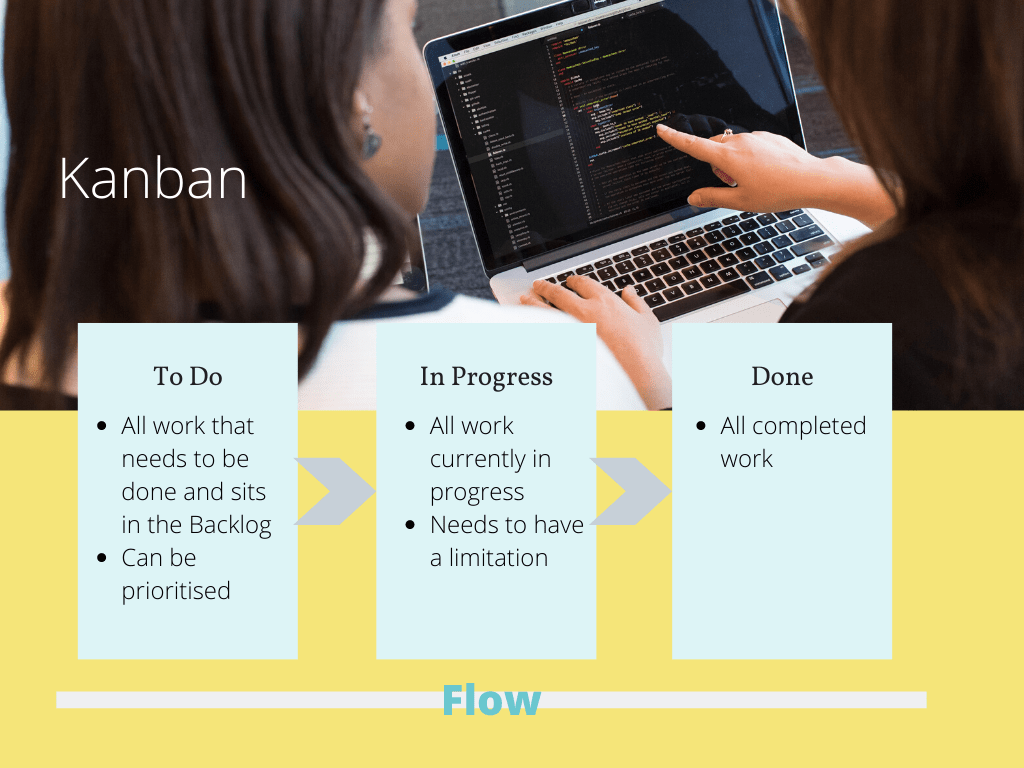
Visuals: This can mean from using post-its in the office to summarise work, to using applications that were built to support Kanban Boards that can help you represent visually how to work flows through the process.
WIP Limitations: By imposing some limits on how much work can be in progress, we can control the focus, as well as avoid bottlenecks and confusions.
Limitations can be done by taking into consideration team size and what works for the project.
A few major benefits for Kanban are:
- Its high-responsiveness to change
- Customer-centricity
- Faster delivery
- Ease of implementation due to reduced cost.
When it comes to visualising the work stream, we can use the Kanban board. As mentioned above, we can build it using post-its, drawing board, or by using apps (such as VersionOne, Asana, Trello, Jira).
Applicability
Kanban seems, at a first glance, quite easy and applicable in a multitude of projects.
However, this is not always the case.
Types of projects Kanban is applicable to:
- Fast-changing needs with small pieces of work
- Long-term planning is not a major focus
Example: Maintainance projects
Types of projects Kanban is not applicable to:
- Long-term planning is a must, with large (although sometimes undetailed) features to be implemented
- Iterative processes required (for progress measurements, planning)
Read Also:
You might be interested to read more technical posts – check out my posts here
Or go through Agile and what it means – here
Leave me a note:
If you have some ideas or want to share your thoughts on remote working and how to handle it, please drop a few lines on
say-hello@projectmanagementlifopedia.com

 Silvana Comanici-Stoianov